










Below are seven complete guided imagery scripts, written out in full and waiting for you whenever you are ready. The breathing cues and the pauses are already in them, so there is nothing for you to prepare and nothing to get right. Open one, settle, and begin.
You will find the scripts themselves here, rather than a long explanation of them. Take your time choosing, or simply start with the first, which is the gentlest of the seven and a kind place to begin.
The seven scripts
- Fading clouds in an open sky, for letting go of a busy mind
- Golden sunlight on a fear, for anxiety and a worry you keep circling
- Sparks of life, for self-criticism and a sense of disconnection
- An abstract language of light, for noticing what state you are actually in
- The house you have not built yet, for a goal you keep setting aside
- The artist who can paint anything, for focus and creative flow
- Larger than life, for overwhelm and letting go of outcomes
If guided imagery is new to you, you may like to read how guided imagery works first, although none of these scripts assume that you have.
How to use these scripts
There are three ways to work with a script, and each of them is a good way. Choose whichever feels right for where you are today.
If you are guiding someone else, read aloud and allow yourself to go slower than feels natural. Most of us move a little quickly the first time, and that is simply part of learning. Those ten second pauses can feel long while you are the one holding the page, and they are the very moments when the person listening begins to settle, so let them have their full length. It is one of the kindest things you can offer a listener.
If you are practising on your own, record the script on your phone and play it back to yourself. Reading and settling ask for two different kinds of attention, and recording lets you put the page down and simply receive. Record it once, just as it comes out, and let that be enough. Your own voice tends to land more softly than a stranger’s, however practised the stranger may be.
Or read it through twice, close your eyes, and let it come back to you in outline. The exact words will not stay with you, and they do not need to. The shape is what carries you: settle, notice, shift. That three part sequence sits at the heart of the Method, and it is unpacked more slowly in this beginner’s guide to meditating.
A few gentle notes, whichever way you choose. Find somewhere you will not be interrupted, and let your phone rest in another room rather than beside you. Treat the breath counts as an invitation rather than a rule, and if counting to three asks more of you than feels comfortable, simply breathe in your own rhythm and let the numbers go. When a script offers you a line to repeat, say it inwardly, in your own voice. That inner voice is where much of the warmth of this practice lives.
One last thing, and it is worth carrying with you. If restlessness arrives partway through, or a quiet wish to stop, meet it kindly. The sessions understand this as a sign that you have reached something real: “the tricky part of attunement is when we connect to the higher energy of peace, resistance will present itself.” Stay with it for a breath or two if you feel able. You are closer than it feels. And if you would rather set it down for today, that is welcome too. The script will be here next time.
1. Fading clouds in an open sky
For: letting go of thoughts, a first attempt at guided imagery, winding down.
Length: about six minutes read slowly.

Script: fading clouds
Make sure you are comfortable sitting or lying down, and put away anything that might distract you. All you have to do is listen and relax.
Gently close your eyes, and follow your breath as it takes you away.
We will be breathing to the count of three.
Inhale, two, three. Exhale, two, three. (Repeat three times.)
Your mind is a sponge, absorbing the energy it is exposed to. To shift your mind, you must shift your energy. To shift your energy is to change your thoughts. With every breath, you feel your body relaxing.
It is in this moment that you let go of anything bothering you, as you imagine each thought likened to a fading cloud in the vast open sky. It is continuously forming, and floating gently away.
You start to feel a warm, nurturing energy surrounding your body.
Inhale, two, three. Exhale, two, three.
As you pay more attention to this energy, you will notice it is the energy of love. Powerful love now encompasses your entire being, pouring over any negativity you may be feeling. It is this love that breaks barriers, opens your heart, and connects you to your body.
As this energy opens doors throughout your body, you will start to notice a sense of relief and a sense of letting go, a release of the conflict you may be facing in your life at this moment. This energy moves you into a space where you feel connected to your core, whole, and satisfied with who you are.
Acknowledge and remember:
You are not your thoughts, you are not your beliefs, you are your consciousness.
Consciousness is ever learning, ever moving, never complete and never the same. Your beauty is that you are free, free to grow, consciously, in any way you wish.
Inhale, two, three. Exhale, two, three. (Repeat three times.)
Bringing your awareness back to your body, you will feel grounded and supported from within.
Open your eyes and relax. Take one last, steady breath.
2. Golden sunlight on a fear
If you only try one of these, make it this one. It is the clearest example of the difference described further down the page: instead of settling you into a pleasant place and leaving you there, it sends you to find something you are actually afraid of, keeps you looking at it, and then goes to work on how it sits in you.
For: anxiety, a worry you keep circling, healing light practice.
Length: about ten minutes read slowly.

Script: golden sunlight
Make sure you are comfortable in a sitting or lying position.
While gently closing your eyes, follow your breath as it takes you away. We will be breathing to the count of three.
Inhale, two, three. Exhale, two, three. (Repeat four times.)
In this meditation we will shift our awareness from fear to love, from despondence to hope, from panic and doubt to optimism. This is about more than thoughts. It is about energy.
Say the following to yourself, within your mind.
I am open to changing my thoughts.
I am open to receiving love.
I am open to connecting with myself.
Inhale, two, three. Exhale, two, three. (Repeat four times.)
Say the following to yourself, within your mind.
I am connected; I am one.
I am whole; I am love.
I am connected.
Now, imagine yourself in a field. Wildflowers surround you, and their colours are exquisite. You are gazing softly at the distant sunset as a gentle breeze comes up, warm on your skin. At this moment, you feel connected.
Say the following to yourself, within your mind.
I am the creator of my own will.
I am the director of my destiny.
I am powerful.
I am connected.
Inhale, two, three. Exhale, two, three.
Now think of something that you are afraid of. It could be anything. Your level of fear does not have to be intense, so begin with one of your smaller, more manageable fears.
Pause for ten seconds.
Now that you have identified a fear, notice how your body reacts to it. How do you respond? How does it make you feel? Shortness of breath, tension, a general uneasiness, these are all physical responses to fear.
Keeping your eyes closed, focus on your fear. See it before you for what it is. Clear your mind and ask yourself: what is the result of this fear? How does that result cause anxiety?
Take a moment to discover and acknowledge why these thoughts repel you.
Pause for ten seconds.
With your clearer understanding of this fear and what it represents, imagine a sort of golden sunlight. Bring this golden sunlight towards your fear. The light is streaming in, directly from your consciousness. The golden light now transforms the energy of these thoughts into something that will work for you rather than against you.
See the fear change.
See the fear change.
See the fear change.
Your thoughts have now transformed. They represent something less negative than they did. Bring acceptance toward what it has become, a gentler version of the fear that was there before.
Recognise that fear is here to teach us. Fear is not bad in itself. You may be inclined to believe that it is, but in reality everything is neutral until we connect emotion to it.
Focusing your attention on the breath, slowly bring your attention back into your body. When you finish, remember how it felt to convert a negative emotion into a positive one.
Opening your eyes now, you are relaxed. You are connected. You are one with your mind. You are one with your emotions.
3. Sparks of life
For: self-criticism, loneliness, a sense of disconnection.
Length: about seven minutes read slowly.

Script: sparks of life
Close your eyes and settle. Follow the breath until it slows on its own.
Now that you have deepened your awareness, imagine that you are connected to every person on the planet. Imagine each person as a spark of life. Every spark you see holds different colours, a variety of emotions, and energies.
These energies are going through a separate, individual journey that is entirely their own, just as you are. Each one learning, stretching, growing differently yet together.
One of these energies is you. It is a mirror of your energy, a representation of who you are in this very moment.
Pause.
Now focus on the energy you have identified as being you, and begin to send love to this energy, and so to yourself.
Pay close attention to how you feel. Notice your intentions toward yourself, and send positive energy toward your feelings, whatever they may be.
Your spark, your energy, becomes brighter, fuller, more whole and less disconnected.
Love connects.
Love heals.
Love is the key.
So open your heart to receiving love from yourself. This is a love that heals inner conflict and self-judgement, and can open you up to your ability to care for who you are.
As you open yourself to this energy, its presence begins to expand, grow, and transform. Channelling your love, you will begin to see the sparks of energy forming spheres, filled with positivity, love and kindness.
In a moment we will return. To do this, focus your attention on your breath.
Inhale, two, three. Exhale, two, three.
Become aware of your body. Slowly now, begin to open your eyes.
You are now connected to your self love.
4. An abstract language of light
This one is the odd one out, and the closest thing here to pure inner vision. There is no scene for you to build. You simply watch whatever your mind is already doing, which makes the imagery yours rather than ours. It is also the one to reach for if you have ever been told to picture a beach and found nothing there at all.
For: finding out what state you are actually in, observation practice.
Length: about eight minutes read slowly.

Script: abstract language of light
Gently close your eyes and follow your breath as it takes you away. We will be breathing to the count of three.
Inhale, two, three. Exhale, two, three. (Repeat five times.)
For most of your day you are pulled into the task at hand, and you may lose sight of your current emotional state. Only once feelings build to the point where you notice them do you reflect on how you feel about your life. Your state of being is your default emotional state when approaching life. So let us learn how to tap into the unawareness.
Inhale, two, three. Exhale, two, three. (Repeat five times.)
Now that you are relaxed, use the power of your imagination to guide yourself into a place of deep tranquillity.
Relax. Relax. Relax.
Enjoy this moment for what it is. Allow the beauty of your imagination to take you on a mental journey, discovering your inner state of being and exploring it in depth.
As your awareness shifts and grows inward, notice the formations that occupy your mind. These forms may present themselves visually. See them as colours. See them as patterns. See them as an abstract language of light interacting in the very depths of your mind’s eye.
Observe the movement.
Observe how they flow.
Observe the power of consciousness.
How does watching this inner display of colours, shapes and formations make you feel?
You have layers within your mind which act automatically, by default. As you move toward understanding, you can take a step back from thinking and move into a state of observation. Observe what is being revealed to you, and allow yourself to relax.
Inhale, two, three. Exhale, two, three.
Use your inner vision to focus on the subtle energy of your emotions. Try to understand how they flow through your body.
Say within your inner voice:
I connect with my state of being.
And repeat once more.
I connect with my state of being.
Say within your inner voice:
I connect with my feelings and my emotions.
I step away from my mind’s eye, and step into a realm of emotion and feeling.
Inhale, two, three. Exhale, two, three.
Open your eyes and relax.
5. The house you have not built yet
For: a goal you keep stalling on, mental blocks, creative flow.
Length: about nine minutes read slowly.

Script: the house you have not built yet
Close your eyes and relax.
Inhale, two, three. Exhale, two, three. (Repeat three times.)
It is always better to move towards a goal from a place of positive mental flow than from a place of difficulty. We do not always need to know the exact steps. We need the drive and the willingness to learn as we go.
Inhale, two, three, four, five. Exhale, two, three, four, five. (Repeat three times.)
We will be focusing on creative flow, and on getting lost in the moment. Allow your mind to drift and to wander. Try not to dwell on the constructs that appear. Allow them to drift by unhindered. Observe them as you would while watching a television show, without getting too attached. Let the visuals be what they are. Let your emotions be.
Inhale, two, three. Exhale, two, three.
Now, whatever your next thought may be, engage with it for what it is. Allow it to become your focus. How does this thought make you feel? What is it giving you? Does it benefit or hinder your experience?
Now move away from that thought, and bring your imagination towards seeing a house. This house is a mental construct of wonderment. The home of your dreams.
It could have high ceilings, a swimming pool, a beautiful view. Let your imagination invent whatever you desire as your perfect home.
Pause.
Now imagine you are required to make this dream a physical possibility. Is the thought of acquiring this home giving you a feeling of difficulty, or of ease? How much work and time would you need?
Inhale, two, three. Exhale, two, three. (Repeat three times.)
If our resources are limited, most of us will find building a dream home difficult. The point of this meditation is not the how, and not the why. It is our approach to achieving goals, however far reaching they feel. It is our emotional and mental connection to the cause that matters.
Now stop counting, and simply notice your breathing as it is.
Pick a personal short term goal, something you hope to achieve within the month to come, however big or small. Allow the fears, the difficulties, and any negative attachment you hold towards it to be what they are.
Breathe gently, holding this goal in place.
See yourself completing the goal, and reaping the rewards.
You see yourself reaching the goal.
The focus is on grounding yourself and reaching it, not on worrying about how and why.
Inhale, two, three. Exhale, two, three.
This exercise was intended to break through the mind’s resistance and move you toward what you actually want. Open your eyes and relax.
6. The artist who can paint anything
For: focus, building your capacity to visualise, understanding what your mind is telling you.
Length: about eight minutes read slowly, with long pauses.

Script: the artist
Close your eyes and relax.
Pause for ten seconds.
We will start slowly and build our way up into a level of consciousness that is in sync with the higher mind. This connection is letting go of the ego mind and focusing on the higher self. Give intent to connect with the higher self.
Repeat the following:
I connect with my highest potential.
I connect to my innermost self.
I let go of any limiting beliefs or emotions preventing me from achieving my highest state of being.
Pause for fifteen seconds.
You have now entered a safe space where you can explore yourself in new ways. Allow a moment to breathe.
Inhale, two, three. Exhale, two, three. (Repeat three times.)
When we are aligned, we are balanced between our inner and outer worldviews. This helps us rekindle our innermost essence and reconnects us to our core selves, without the ego.
Inhale, two, three. Exhale, two, three. (Repeat three times.)
Allow your emotions to stabilise. Allow your mind to still and calm. As we begin this journey, allow yourself to be a co-creator in the experience.
Pause for ten seconds.
Imagine that you are a famous artist, someone who, with their imagination, can paint anything with perfect accuracy. This freedom to bring the imagination into the physical is powerful.
Pause for ten seconds.
Allow yourself a moment to sense what you would like to create.
Pause for ten seconds between each of the following.
Is it a painting, or is it a sculpture?
What is surrounding the artwork?
Is it outdoors or indoors, and how is the lighting?
Is it bright, or is it dark?
As you create your inner artwork, what do you feel its meaning is to you?
Is it something you can use within your life, and how does it make you feel?
Pause for ten seconds.
Everything within consciousness is a mirror, and within deep meditative states the mind works with metaphors in order to show you meaning.
Open your eyes and breathe gently.
7. Larger than life
For: the feeling that you have to control everything, overwhelm, letting go of outcomes.
Length: about seven minutes read slowly.

Script: larger than life
Before closing your eyes, run through this thought.
Imagine that you were very small. Everything around you becomes bigger, and your vision of the world becomes larger. Your sense of reality is magnified. Now shrink yourself again, one level smaller, which doubles the size of your perception of your surroundings.
Now, holding that thought of being smaller, close your eyes and relax.
With this perception of being smaller, what was the first feeling that stood out to you? We are all different, so this varies from person to person, but on average your sense of power shifts. You may feel more physically vulnerable to the outer world.
Inhale, two, three. Exhale, two, three. (Repeat three times.)
As you move inward, take note of the physical. How your body now feels. Connect with your body.
Repeat the following with your inner voice:
I connect with my body.
I am connected with my body.
Now that you have connected more deeply to your body, with the inner vision of being smaller than normal, imagine that everything around you is larger than life.
You cannot interact with the objects around you. You are too small to move any of them. With this sense of being smaller than life, feel the detachment from physical reality. You are unable to change anything significant. It is through this angle that we become the observer.
Inhale, two, three. Exhale, two, three. (Repeat three times.)
We watch the world around us changing through time, without us affecting it physically. We move into the world of being and thought. We notice a shift in our worldview: the world is changing without us having to interact with it.
Inhale, two, three. Exhale, two, three. (Repeat three times.)
The lesson is to observe. We do not always have to be the one in charge. The world is turning on its own. We are here to take part in it, but we do not control every outcome. The awareness of being small reminds us that we will not control every step of the journey, and that the universe continues regardless.
Open your eyes and breathe gently.
What makes these different from most guided imagery scripts
Picture a beach. Warm sand underfoot, water somewhere ahead of you, sun on your face. That is how most guided imagery works, and it works perfectly well. You build a pleasant place in detail, you stay there a while, and you come out calmer than you went in.
These scripts treat the scene differently. The place you build is not where you are going. It is where the work happens.
To shift your mind, you must shift your energy. To shift your energy is to change your thoughts.
So there are three movements rather than one. You settle. You notice what is honestly there, in your thoughts and in the feeling sitting underneath them. Then you change its charge, using what the sessions call inner dialogue: short lines repeated in your own inner voice, deliberately, to turn one state into another.
The second script shows this most clearly. A conventional version would have you imagine golden light and rest in the warmth of it, and that would be the whole exercise. This one sends you looking for something you are afraid of first, keeps you with it until you can see it properly, and only then brings the light to that particular thing and holds it there until something gives. The imagery is the tool. The change is the point.
It is also why these scripts keep reaching for the word energy where you might expect calm. What you are working on is your state of being, which the sessions describe as your default emotional setting, the mood you meet your life in before anything has happened to you that day. It is the same ground covered in what spiritual healing actually means. And nothing moves until you have been honest about where that setting currently sits: “acceptance is the first step toward shifting from a negative to a positive state of being.”
Common questions
How long should a guided imagery script be?
Long enough that you have properly arrived before anything is asked of you, which usually means three or four minutes of breathing before the imagery begins at all. The scripts here run between six and ten minutes read aloud. Much under five and most people simply have not dropped far enough for the imagery to take hold.
Should I read the script aloud or record it?
Record it, if you are practising alone. Reading holds a part of your attention on the page, and that part is precisely what you are trying to let go of. Save reading aloud for when you are guiding someone else.
Can I change the wording?
Please do, with one exception. Move the scenery around as much as you like, swap the field for a shoreline, make the house whatever you want it to be. The lines you repeat are the part to leave alone. They are written in the first person and in the present tense on purpose, and if you do rewrite them, keep both of those things.
What if I cannot picture anything?
You are in good company, and nothing has gone wrong. Research into aphantasia suggests that around one person in a hundred cannot form a visual image at all, and closer to one in twenty-five sees only something dim or vague. Start with the fourth script, which never asks you to build a scene in the first place. It asks you to notice whatever your own mind is already doing. And if there is still nothing to see, work with the feeling instead: where it sits in your body, whether it is heavy or tight or warm, whether it moves. That is the same practice by another route.
Is guided imagery the same as visualisation?
Close enough that most people use the words interchangeably. If you want the distinction, visualisation usually means holding a specific outcome in mind, the way the fifth script has you see yourself reaching a goal. Guided imagery usually means being walked through a sensory scene for the effect of the scene itself. You will find both happening here.
How often should I use them?
Often beats long, every time. The capacity builds through repetition, so ten minutes you genuinely do today is worth more than the half hour you keep meaning to get to.
If you would rather be guided
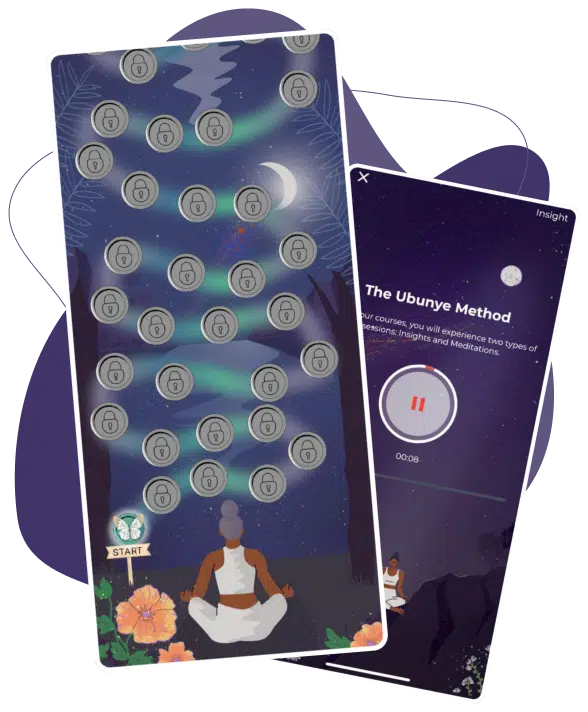
These scripts grew out of the Ubunye Method, a guided course in meditation for spiritual and emotional healing. Reading a script to yourself asks you to hold the page and settle at the same time, and some days that is more than you want to carry. If you would like to simply be led instead, the course walks you through this same work session by session, and the first four sessions are open to you at no cost.
The Ubunye Method provides guided meditation for general wellbeing and personal development. It is not medical advice, diagnosis or treatment, and is not a substitute for professional healthcare. Read our full disclaimer.