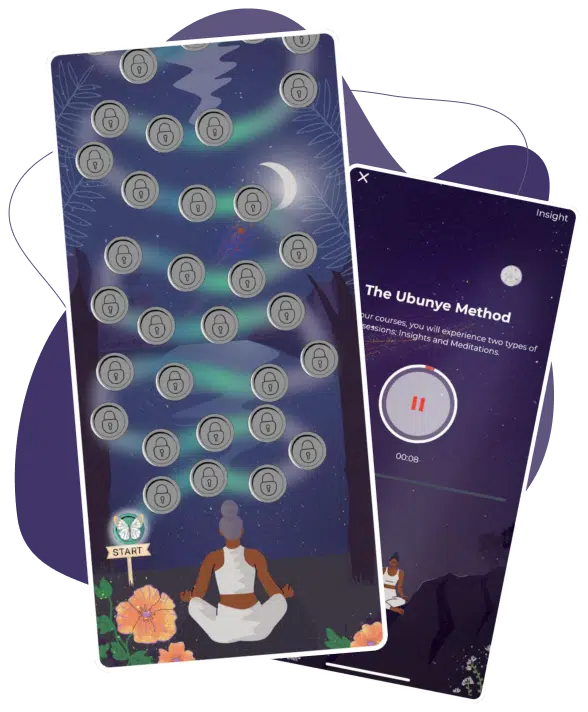















To start meditating with the Ubunye Method, settle your breathing, notice what you are actually carrying, then shift it deliberately using your own inner voice. You are not trying to empty your mind. You are working with what is already in it, and changing its charge.
That last part is what separates this from most beginner guides, and it is worth understanding before you sit down for the first time.
This is not about silencing your mind
Most introductions to meditation teach a single move: watch the breath, notice a thought, let it pass. That is a real skill, and it is where the Method starts too. It is not where it stops.
Chapter 1 states the principle plainly:
To shift your mind, you must shift your energy. To shift your energy is to change your thoughts.
So there are three movements, not one. You settle. You notice what is actually there, in your thoughts and in the feeling underneath them. Then you change it, using a technique the Method calls inner dialogue: affirmations repeated in your own inner voice, deliberately, to convert one state into another.
The Method has a name for the thing you are changing. It calls it your state of being: “when you connect to your energetic state, you are connecting with your current state of being, your present self.” The sessions describe the work as adjusting “from a lower state of being to a higher state of being”, and they are clear about what has to come first: “acceptance is the first step toward shifting from a negative to a positive state of being.”
That is why the noticing cannot be skipped. You accept what is actually there, and only then does it move.
The sessions are explicit that this runs through the whole course: “we will be using a technique of inner dialogue whereby we repeat affirmations within the mind. We will be using this inner dialogue and affirmation technique throughout the Ubunye Method.”
Watching a thought drift past leaves you calmer. Converting the energy underneath it leaves you somewhere else entirely. The second is the work.

Four things people think they need, and do not

You must empty your mind
You do not, and this practice does not ask you to. Your thoughts and the feelings under them are the material you work with, not interference to be cleared before the real thing starts.

You need twenty minutes
Two minutes done daily beats twenty minutes done once a fortnight. Short and regular builds the habit; long and occasional mostly builds the feeling that you are bad at this.

You need to sit cross legged
You do not. Sit, lie down or stand, whichever lets you be comfortable and rest. That is the only requirement, because comfort is what allows inner awareness to come. The Method asks simply that you are “comfortable in a sitting or lying position” with distractions put away.

You need a quiet room
Helpful, not required. Sound is only a problem when you decide it is one. Traffic, a fridge, someone else in the house: all of it can be part of what you are noticing rather than an obstacle to it.
How to meditate, step by step
The first time, keep it short. Two to five minutes is plenty, and finishing wanting slightly more is a better outcome than finishing relieved it is over.
1. Pick a time you can defend
First thing in the morning works for most people, because the day has not yet started making claims on you. The specific time matters less than it being the same time, since that is what turns it into a habit rather than a decision you make again each day.
2. Get comfortable, however that works for you
Sit, lie down or stand. There is no correct posture and no wrong one. The Method’s only instruction is to be “comfortable in a sitting or lying position” with distractions out of reach. If lying down lets you rest more easily than sitting, lie down.
3. Settle with the breath
In for a count of three, out for a count of three. Four or five rounds. This is not the practice itself, it is what makes the practice possible: it quietens things enough that you can hear what is underneath.
4. Notice what is actually there
Now look. What are you carrying today? Not the story about it, the feeling itself, and where it sits. Jaw, chest, stomach, shoulders. The Method asks you to pay “close attention to how you feel” and to notice your intentions toward yourself. Name it plainly and do not argue with it.
5. Shift it with your inner voice
This is the step most guides leave out, and it is the one that does the work. Choose a short affirmation that meets what you found, and repeat it slowly in your own inner voice. Not aloud, and not quickly. From the sessions: “I am more than my emotions.” “I am open to changing my thoughts.” “I create flow through opening up to my tension.” Give each one a few breaths rather than rushing a list.
6. Rest in the new state, then return
Stay a moment with whatever shifted, even slightly. That resting is not an afterthought; it is how the new state settles. What you are settling into has a name too: the Method calls it flow, and ties it to alignment in one of its own affirmations, “I flow when I am aligned; I am aligned when I flow.” Then bring your attention back to the room, take one more breath, and open your eyes.
Why affirmations, and why this is not positive thinking
Affirmations have a reputation problem, and it is deserved wherever they amount to telling yourself things you do not believe.
That is not what is happening here, and the order is the reason. You settle first. You look at what is genuinely there second. Only then do you work with it. You are not skipping over the feeling, you are meeting it and then deliberately changing its charge. The Method describes the outcome as conversion rather than denial: after a session it asks you to “remember how it felt to convert negative emotions to positive ones.”
It also treats the difficult feeling as useful rather than as an enemy: “fear is here to teach us. Fear is not bad in itself.” Nothing is being evicted. What changes is what it is made of.
If an affirmation feels untrue when you say it, that is not a signal to back off. It is the old belief pushing back against it.
The Method names this directly: “the tricky part of attunement is when we connect to the higher energy of peace, resistance will present itself.” Resistance is defined as “a barrier within the mind, which contains the connections, thoughts, and beliefs that deny us inner peace.” Meeting that barrier is what is supposed to happen when you reach past it.
The push back is roughly proportional to how firmly the old belief is held, which means the statements that feel least true are usually the ones aimed at something real. What overrides it is repetition: the same affirmation returned to across sessions until the positive energy behind it outweighs the negative energy behind the belief it is displacing. Not force, and rarely in one sitting.

A five minute guided practice
A shortened version of An Introduction to Guided Meditation, the second session in Chapter 1 and one of the four that are free.
- Settle. Sit, lie or stand comfortably, put your phone out of reach, and close your eyes.
- Breathe to a count of three. In for three, out for three. The Method is explicit that this is a guide, not a test: “if you struggle to slow down, just try to focus on breathing as naturally as possible.”
- Let the first wave pass. As each thought arrives, picture it, in the session’s own words, “likened to a fading cloud in the vast open sky” that is “continuously forming and floating gently away.” You are not pushing them off. You are clearing enough space to work.
- Find the feeling underneath. Below the thoughts there is usually a tone: tight, heavy, restless, flat. Let your attention rest there without trying to fix it.
- Change its charge. In your inner voice, slowly, a few breaths each: “I am more than my emotions.” “I am calm.” “I am centred.”
- Let the new state arrive. The session describes a “warm, nurturing energy” that “pours over any negativity you may be feeling.” Do not manufacture it. Leave room for it.
- Return. Bring your awareness back to your body, take one more breath, and open your eyes.
The full guided version is free in the app, and having a voice lead it removes the part most beginners find hardest, which is deciding what to do next.
Why your mind will not slow down, and why that is fine
This is the single most common reason people stop, so it is worth being clear about.
Your mind racing during meditation is not evidence that you cannot meditate. It is evidence that you have stopped moving long enough to notice what your mind was already doing. The noise was there before you sat down. You have simply removed the distractions that were covering it.
You did not make your mind noisier. You made it audible.
Audible is what you need, because you are not trying to get rid of it. Here the noise is the raw material. You cannot shift a state you have not noticed, so a racing mind is not an obstacle to the work. It is the beginning of it.
Session 2 ends on the distinction that makes this possible: “you are not your thoughts, you are not your beliefs, you are your consciousness.” Thoughts are something you have, not something you are, which is exactly why their charge can be changed.

How to keep going past the first week
Starting is easy. The second week is where it usually ends.
- Anchor it to something you already do. Straight after brushing your teeth, before your first coffee. New habits stick to old ones more reliably than they stick to intentions.
- Keep it embarrassingly short. Two minutes is genuinely enough at the start. You can extend it once missing it feels strange.
- Expect to miss days. Missing one day is normal. What ends practices is deciding that missing one day means you have failed.
- Do not judge the session while you are in it. A session that felt scattered is not a wasted session. You rarely have a useful opinion about it at the time.
The Method describes taking it slowly on purpose: “in the beginning, we will take it slow and ease you in.” The sequencing is deliberate, and starting gently is not a lesser version of starting.
Common questions
How long should I meditate as a beginner?
Two to five minutes. Longer sessions are not better when you are starting; they just make the habit harder to keep. Build the routine first and the duration extends on its own.
Am I doing it wrong if I cannot stop thinking?
No, and stopping thought is not the aim here. The Method works with your thoughts and the feelings under them rather than switching them off. Noticing what is there is step one of the practice, not evidence you have failed at it.
Do affirmations actually work?
With repetition, yes. An affirmation works by putting positive energy behind a statement until it outweighs the belief already sitting in that place. The first few times it may feel untrue, and that is the old belief resisting rather than proof it is not working. Returning to the same affirmation across sessions is what shifts it.
Do I need a guided meditation or can I sit in silence?
Either works, but guided is usually easier at the start. Being led means you are not simultaneously trying to do the practice and decide what the practice is.
What if I fall asleep?
That is fine. If you drift off, your body was asking for rest and took it, and rest is not in competition with the practice. If you would rather stay awake, sitting or standing usually does it, but falling asleep is not a session wasted.
Where to begin
The first four sessions of the Ubunye Method are free and need no card. The second is the guided introduction quoted above, and it assumes no experience at all. If anxious thinking is what makes sitting still difficult, meditation for anxiety covers that directly, and what spiritual healing means explains where this work leads.
The Ubunye Method provides guided meditation for general wellbeing and personal development. It is not medical advice, diagnosis or treatment, and is not a substitute for professional healthcare. Read our full disclaimer.